
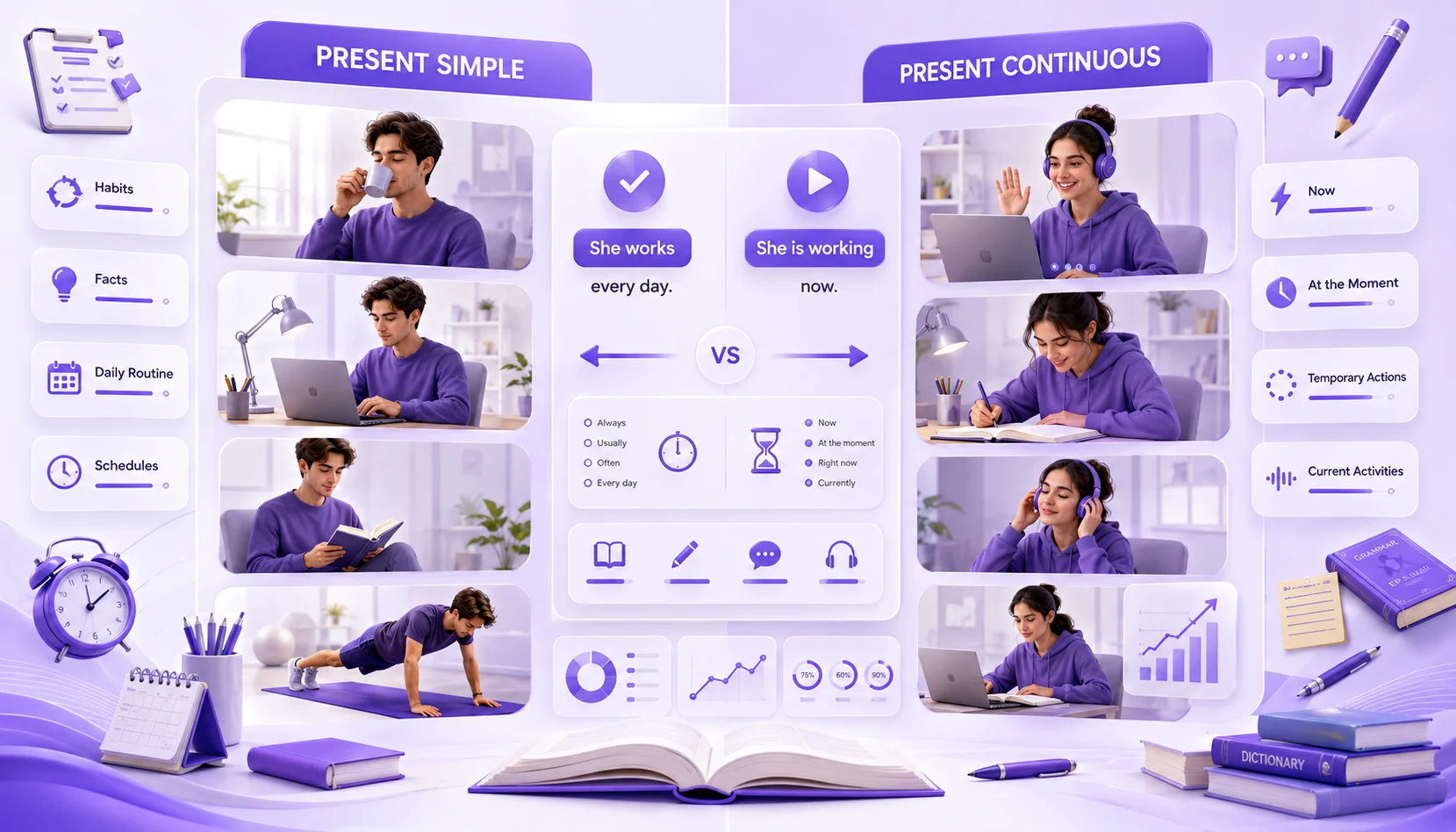
Present Simple vs Present Continuous: What's the Difference?
The Present Simple and Present Continuous are two of the most important English tenses. Beginners often confuse them because both describe actions happening in the present, but they are used in different situations.
Understanding when to use each tense will improve your speaking, writing, reading, and listening skills.
In this guide, you'll learn the rules, sentence structures, examples, common mistakes, and practice exercises to master both tenses.
💡 Tip: Take the Grammar Test on TryEnglishTest.com after reading this article to check your understanding.
What Is the Present Simple?
The Present Simple is used to describe:
- Daily routines
- Habits
- Facts
- General truths
- Permanent situations
- Timetables
Examples
- I drink coffee every morning.
- She works in a hospital.
- The Earth goes around the Sun.
- They play football on Sundays.
What Is the Present Continuous?
The Present Continuous describes actions happening:
- Right now
- Around the present time
- Temporary situations
- Changing situations
- Future arrangements
Examples
- I am studying English now.
- She is talking on the phone.
- They are watching a movie.
- We are meeting our teacher tomorrow.
Present Simple Structure
Positive
Subject + Verb (base form / s-es) + Object
Examples
- I work every day.
- He works every day.
- They study English.
Negative
Subject + do/does + not + base verb
Examples
- I do not like coffee.
- She does not watch TV.
Questions
Do/Does + Subject + Base Verb?
Examples
- Do you speak English?
- Does he work here?
Present Continuous Structure
Positive
Subject + am/is/are + verb + ing
Examples
- I am reading.
- She is studying.
- They are playing football.
Negative
Subject + am/is/are + not + verb + ing
Examples
- I am not sleeping.
- He isn't working.
- They aren't listening.
Questions
Am/Is/Are + Subject + Verb + ing?
Examples
- Are you studying?
- Is she cooking?
- Am I late?
When to Use the Present Simple
Use the Present Simple for:
-
Habits
- I brush my teeth twice a day.
- She walks to school.
-
Daily Routines
- He wakes up at 7 a.m.
- We eat dinner at 8 p.m.
-
Facts
- Water boils at 100°C.
- Cats like milk.
-
Permanent Situations
- I live in Morocco.
- She works in London.
-
Scheduled Events
- The train leaves at 9:00.
- School starts next Monday.
When to Use the Present Continuous
Use the Present Continuous for:
-
Actions Happening Now
- I am reading a book.
- They are playing football.
-
Temporary Actions
- She is staying with her aunt this week.
- I am working from home today.
-
Changing Situations
- Your English is improving.
- The weather is getting warmer.
-
Future Plans
- We are flying to Paris next week.
- She is meeting her friend tomorrow.
Present Simple vs Present Continuous Comparison
| Present Simple | Present Continuous |
|---|---|
| Daily routines | Actions happening now |
| Habits | Temporary actions |
| Facts | Changing situations |
| Permanent situations | Future arrangements |
| Timetables | Current activities |
Example Comparison
Present Simple:
I work in a bank.
(This is my permanent job.)
Present Continuous:
I am working from home today.
(This is temporary.)
Present Simple:
She drinks coffee every morning.
Present Continuous:
She is drinking coffee right now.
Present Simple:
They play football every Saturday.
Present Continuous:
They are playing football at the moment.
Signal Words
Present Simple
- Always
- Usually
- Often
- Sometimes
- Never
- Every day
- Every week
- On Mondays
Example: She always arrives early.
Present Continuous
- Now
- Right now
- At the moment
- Today
- This week
- Currently
- Look!
- Listen!
Example: Look! The baby is sleeping.
Common Mistakes
- ❌ I am knowing the answer.
✅ I know the answer. - ❌ She is going to school every day.
✅ She goes to school every day. - ❌ He works now.
✅ He is working now. - ❌ They are play football.
✅ They are playing football. - ❌ I am understand.
✅ I understand.
Practice Exercises
Choose the correct answer.
-
She ______ to work every day.
- A) go
- B) goes
- C) is going
✅ Answer: B
-
Look! The dog ______.
- A) runs
- B) is running
- C) run
✅ Answer: B
-
We ______ English every Monday.
- A) study
- B) are studying
- C) studying
✅ Answer: A
-
Listen! Someone ______ at the door.
- A) knocks
- B) is knocking
- C) knock
✅ Answer: B
-
My father ______ coffee every morning.
- A) drinks
- B) is drinking
- C) drink
✅ Answer: A
Quick Quiz
Choose the correct sentence.
-
I ______ TV every evening.
- watch
- am watching
-
She ______ dinner right now.
- cooks
- is cooking
-
They ______ in Spain.
- live
- are living (temporary)
Tips for Remembering
✅ Present Simple = Habit
✅ Present Continuous = Now
If you can answer "every day?", use the Present Simple.
If you can answer "right now?", use the Present Continuous.
Frequently Asked Questions
What is the main difference?
The Present Simple describes habits, routines, and facts, while the Present Continuous describes actions happening now or temporary situations.
Can both tenses talk about the future?
Yes.
Present Simple is used for schedules:
- The train leaves at 8:00.
Present Continuous is used for personal arrangements:
- I'm meeting my teacher tomorrow.
Which tense should beginners learn first?
Start with the Present Simple because it is the most common tense in everyday English. Then learn the Present Continuous.
Why can't I say "I am knowing"?
Some verbs, called stative verbs (know, like, love, understand, believe), are usually not used in the Present Continuous.
Correct:
- I know the answer.
Incorrect:
- I am knowing the answer.
Final Thoughts
The Present Simple and Present Continuous are essential building blocks of English grammar. Once you understand the difference between habits and actions happening now, you'll find it much easier to speak and write correctly.
Practice these tenses every day by creating your own sentences, paying attention to signal words, and noticing how native speakers use them in conversations.
The more you practice, the more natural these grammar patterns will become.
Test Your Grammar Today!
Ready to check your understanding?
Take the Grammar Test on TryEnglishTest.com to practice the Present Simple, Present Continuous, and many other essential English grammar topics. You'll receive instant feedback and discover which areas you should improve next.
Start practicing today and build a stronger foundation in English grammar!