Days of the Week in English: Names, Order and Usage
Learn all seven days of the week, correct spelling and capitalization, and how to talk about your weekly routine.
What you will learn
The days of the week help us make plans, talk about classes and describe routines. You will learn their order, spelling, and useful sentences with “on”.
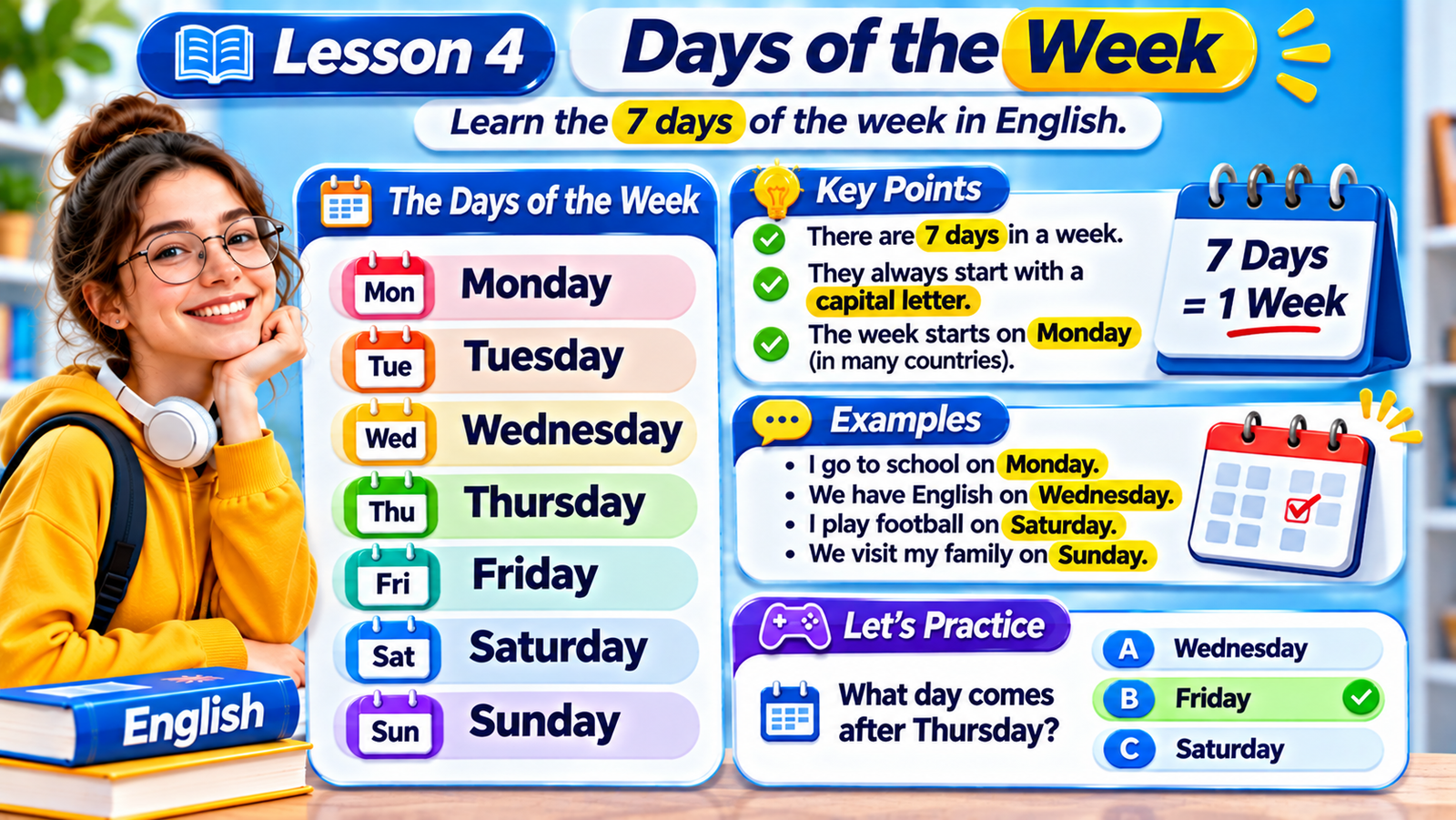
1. The seven days
| Order | Day | Example |
|---|---|---|
| 1 | Monday | I study on Monday. |
| 2 | Tuesday | We play football on Tuesday. |
| 3 | Wednesday | My class is on Wednesday. |
| 4 | Thursday | She works on Thursday. |
| 5 | Friday | We meet on Friday. |
| 6 | Saturday | I visit my grandparents on Saturday. |
| 7 | Sunday | I rest on Sunday. |
Calendars in different countries may start on Sunday or Monday. The sequence of days is the same.
2. Capital letters and spelling
In English, day names always begin with a capital letter: Monday, not monday. Watch the spelling of Wednesday (the d is often not clearly pronounced) and Thursday (starts with Th).
Common abbreviations include Mon, Tue, Wed, Thu, Fri, Sat and Sun. They are useful on calendars, but write the full day name in beginner exercises.
3. Today, tomorrow and yesterday
Today means the current day. Tomorrow means the next day. Yesterday means the day before today.
If today is Tuesday, yesterday was Monday and tomorrow is Wednesday.
A: What day is it today?
B: It is Tuesday.
A: What day is tomorrow?
B: Wednesday.
4. Use “on” with days
Use on before a specific day: on Monday, on Friday, on Sunday. You can also say on Monday morning or on Saturday evening.
To describe a repeated routine, use every Monday or on Mondays: “I practise English every Monday.” Do not say “in Monday”.
5. Weekdays and weekend
In many English-speaking contexts, weekdays means Monday to Friday, while the weekend is Saturday and Sunday. Work and school schedules vary, so the word “weekend” does not guarantee everyone has time off.
Mini dialogue:
A: Are you free on Saturday?
B: Yes. Let’s study English on Saturday afternoon.
6. Practice and common mistakes
- Incorrect: I study in Monday. Correct: I study on Monday.
- Incorrect: my class is on friday. Correct: My class is on Friday.
- Incorrect: Today Monday. Correct: Today is Monday.
Your turn: Write three sentences about your week. Say which day you study English, which day you shop, and what you do on Sunday. Read your sentences aloud.
Lesson recap
Review the key patterns above, listen again to the examples, complete the quiz, and play the matching game. For lasting progress, practise the new words in your own sentences.
Listen, Practice & Play
Listen to the examples, check your understanding, and match related expressions. Audio uses your device's text-to-speech voice.
Listen & Repeat
Select a sentence to listen.
Knowledge Quiz
Matching Game
Choose one item on the left and its match on the right.
Finished studying this lesson?
Mark it complete to save your progress on this device.