A, An and The: English Articles for Beginners
Use a, an and the naturally with singular nouns, sounds, familiar things and everyday examples.
Learning goals
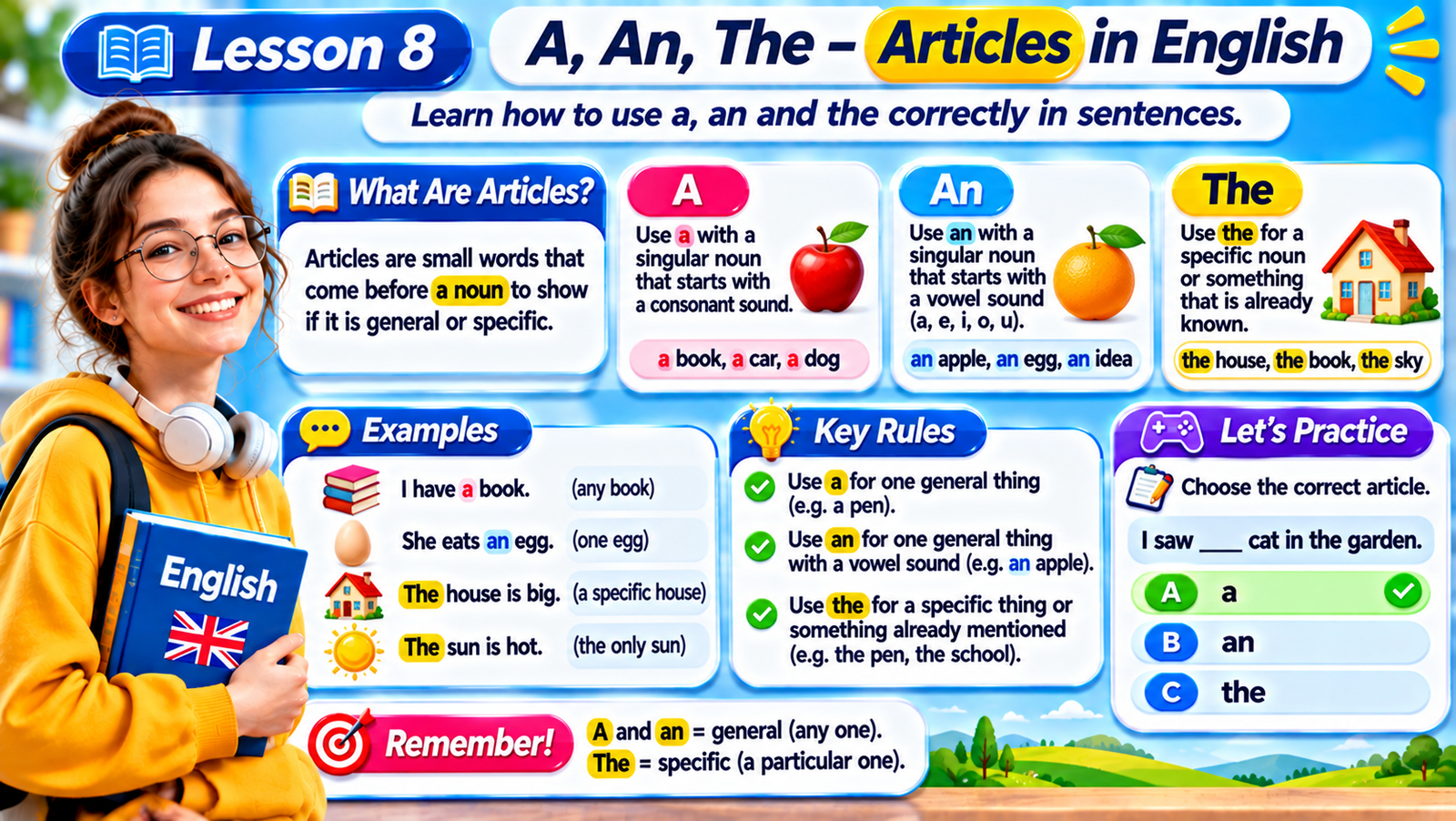
Small words can make a big difference. A, an and the are articles. They help listeners understand whether we mean something general or something specific.
1. Use a and an for one nonspecific thing
Use a or an before a singular countable noun when the listener does not know which one: “I need a pen.” “She has an umbrella.” You cannot normally say “I need pen.”
Use a before a consonant sound and an before a vowel sound. The sound matters more than the first letter.
2. Listen to the first sound
| Article | Example | Why? |
|---|---|---|
| a | a book | Starts with a /b/ sound |
| an | an apple | Starts with a vowel sound |
| a | a university | Starts with a /y/ sound |
| an | an hour | The h is silent; starts with a vowel sound |
| an | an honest person | The h is silent |
Say the whole phrase aloud rather than memorizing only the first letter.
3. Use the for something specific
Use the when the listener can identify what you mean: “Please close the door.” “I bought a book. The book is interesting.” The first mention introduces the book; the second mention refers to that same book.
We also use the for many unique things in context: “the sun,” “the teacher in our classroom.”
4. Sometimes no article is needed
Plural and uncountable nouns can be used without an article when speaking generally: “Dogs need exercise.” “Water is important.” Compare “Dogs are friendly” (dogs in general) with “The dogs in this park are friendly” (a particular group).
Do not use a with a plural noun: “a books” is incorrect. Say “a book” or “some books.”
5. At a café: real conversation
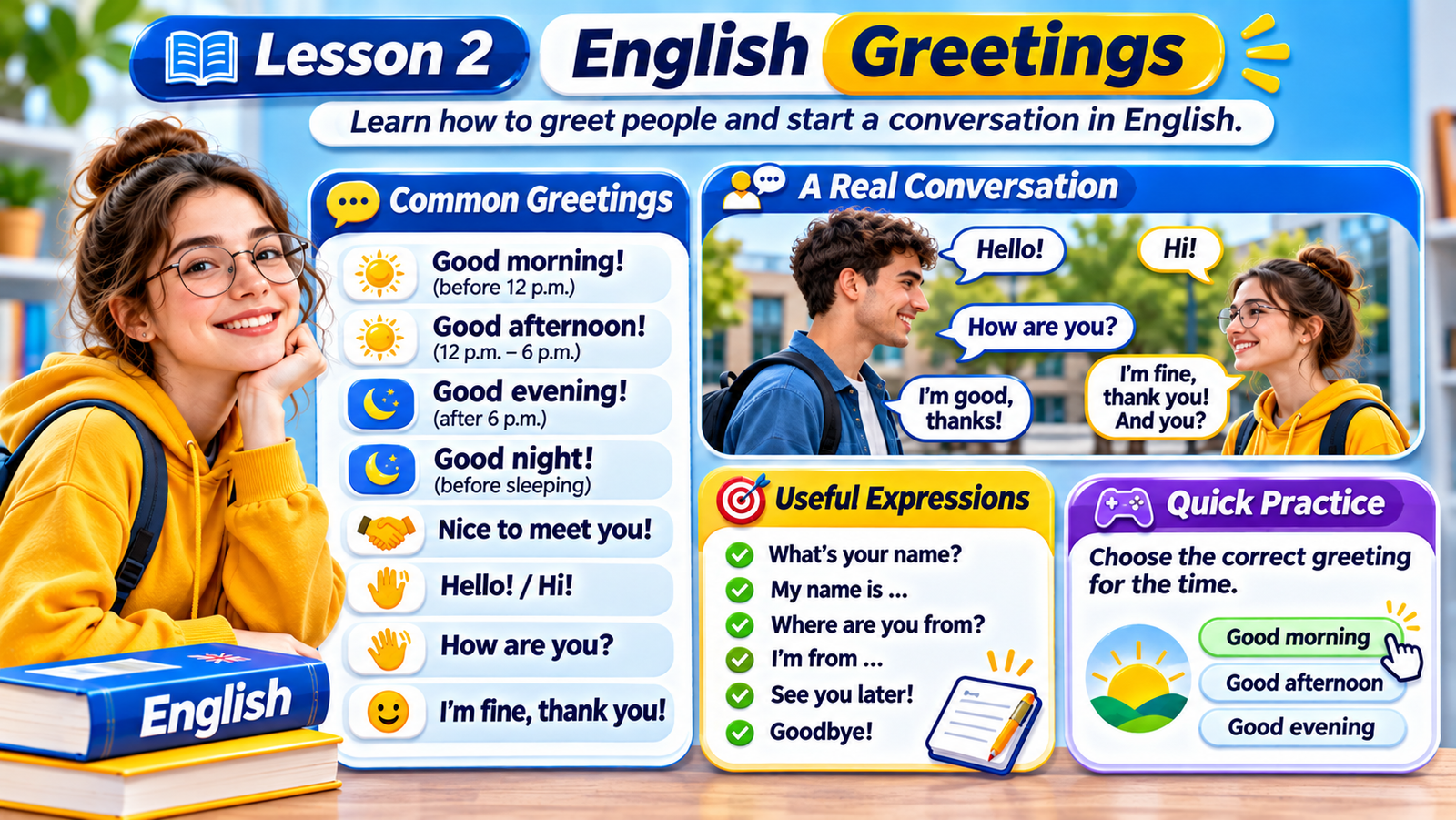
Customer: Can I have a sandwich and an orange juice, please?
Server: Of course. Would you like the sandwich toasted?
Customer: Yes, please.
Server: Here is your order.
Customer: Thank you!
In a café, “an orange juice” can mean a serving of juice, even though juice is usually uncountable.
6. Common mistakes and practice
- Incorrect: an university. Correct: a university.
- Incorrect: a hour. Correct: an hour.
- Incorrect: I bought a book. A book is blue. Better: I bought a book. The book is blue.
- Incorrect: She has a apples. Correct: She has apples.
Practice: Choose a, an, the, or no article: “I saw ___ elephant.” (an); “___ elephant was near a river.” (the); “___ cats like warm places.” (no article). Make two examples of your own.
Self-check and next step
Listen to the examples once at normal speed and once slowly. Complete the quiz without looking back, then replay any phrases you found difficult. Finish with the matching game and write two original sentences using today’s language.
Listen, Practice & Play
Listen to the examples, check your understanding, and match related expressions. Audio uses your device's text-to-speech voice.
Listen & Repeat
Select a sentence to listen.
Knowledge Quiz
Matching Game
Choose one item on the left and its match on the right.
Finished studying this lesson?
Mark it complete to save your progress on this device.