Numbers in English: Count from 1 to 100
Learn to count from 1 to 100, understand tricky number pairs, say ages and prices, and practise numbers in real conversations.
What you will learn
Numbers help us talk about age, prices, addresses, quantities and time. You do not need to memorize every number separately: learn the patterns, then practise saying them aloud.
1. Count from 0 to 20
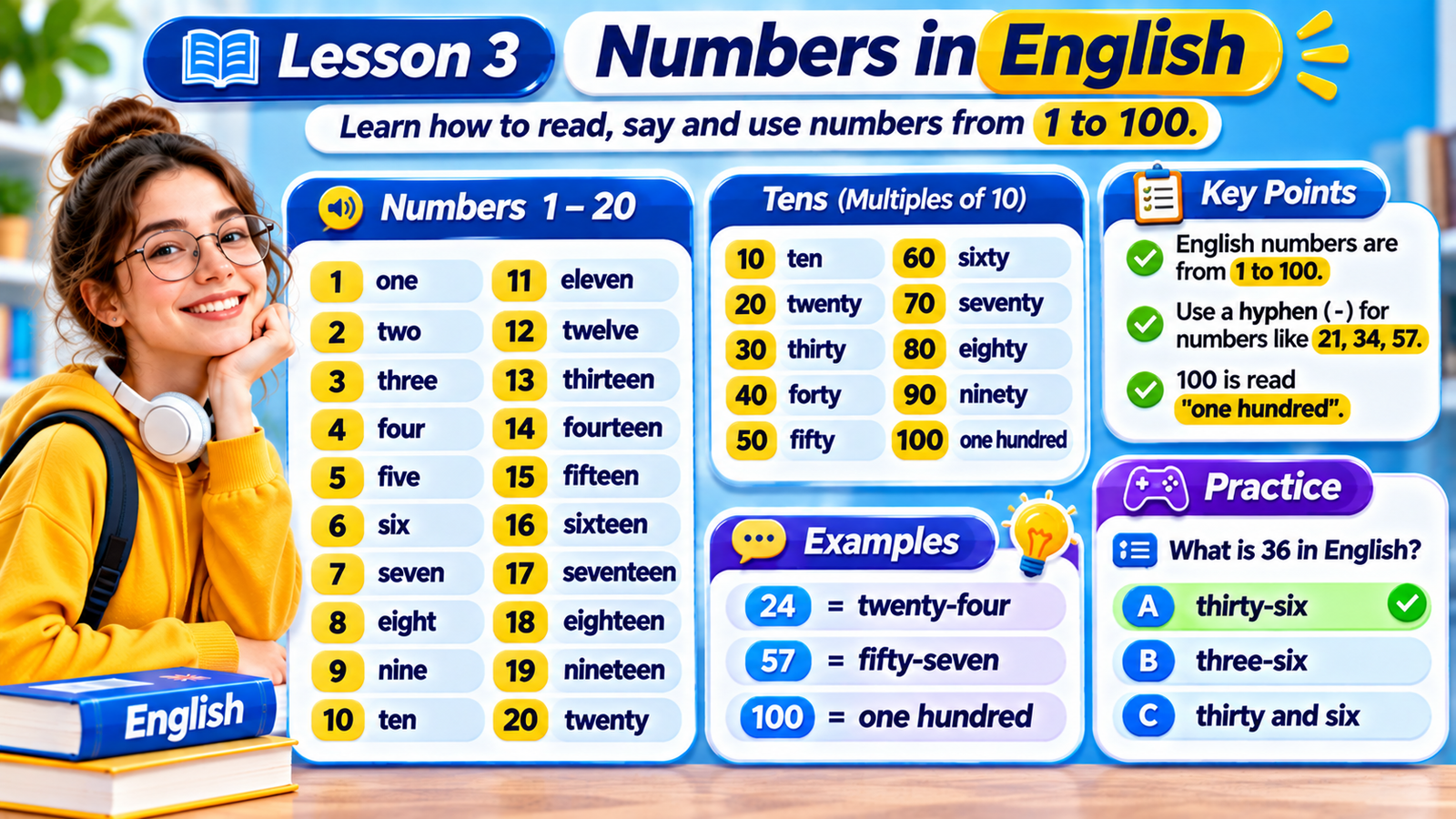
Start with these essential number words. Listen and repeat each one slowly, then try without reading.
| Number | Word | Number | Word |
|---|---|---|---|
| 0 | zero | 11 | eleven |
| 1 | one | 12 | twelve |
| 2 | two | 13 | thirteen |
| 3 | three | 14 | fourteen |
| 4 | four | 15 | fifteen |
| 5 | five | 16 | sixteen |
| 6 | six | 17 | seventeen |
| 7 | seven | 18 | eighteen |
| 8 | eight | 19 | nineteen |
| 9 | nine | 20 | twenty |
| 10 | ten | — | — |
Notice that eleven and twelve have special names. Many numbers from thirteen to nineteen end in -teen.
2. The tens and numbers to 100
Learn the tens: 20 twenty, 30 thirty, 40 forty, 50 fifty, 60 sixty, 70 seventy, 80 eighty, 90 ninety, 100 one hundred. To make 21–99, combine a tens word with a number from one to nine: twenty-one, thirty-six, forty-eight, seventy-two, ninety-nine. Use a hyphen in compound numbers when writing them as words.
Spelling alert: forty, not “fourty”; fifteen, not “fiveteen”; fifty, not “fivety”.
3. Teen or ten?
Listen carefully to thirteen / thirty, fourteen / forty, and fifteen / fifty. In careful pronunciation, teen numbers usually stress the final syllable, while tens usually stress the first syllable. In connected speech, stress can change, so listen to the whole sentence too.
Try it: I have thirteen books. / I have thirty books. Which sentence describes more books?
4. Numbers in everyday life
Age
A: How old are you?
B: I am twenty-four years old.
Shopping
A: How much is the notebook?
B: It is fifteen dollars.
Quantity
A: How many chairs are there?
B: There are thirty-two chairs.
Use How many for countable things, and How much to ask about price.
5. Common mistakes
- Incorrect: I have twenty one books. Better: I have twenty-one books.
- Incorrect: She is twenty years. Correct: She is twenty years old.
- Incorrect: Fourty. Correct: Forty.
6. Your turn
Write these numbers in words: 18, 27, 40, 63, 95. Then say them aloud. Answers: eighteen; twenty-seven; forty; sixty-three; ninety-five.
Speaking challenge: Tell a partner your age, the number of books in your bag, and the price of something you bought recently. Use full sentences.
Lesson recap
Review the key patterns above, listen again to the examples, complete the quiz, and play the matching game. For lasting progress, practise the new words in your own sentences.
Listen, Practice & Play
Listen to the examples, check your understanding, and match related expressions. Audio uses your device's text-to-speech voice.
Listen & Repeat
Select a sentence to listen.
Knowledge Quiz
Matching Game
Choose one item on the left and its match on the right.
Finished studying this lesson?
Mark it complete to save your progress on this device.