English Greetings and Introductions: Say Hello and Meet People
Learn everyday English greetings, introduce yourself, ask names, respond to How are you, and say goodbye with real dialogues, speaking practice, and a quiz.
What you will learn
When you meet someone, the first few words help you start a friendly conversation. In this lesson, you will greet people, introduce yourself, ask for a name, respond politely, and end a short conversation. Read the examples aloud and try the activities without looking at the answers.
Learning goals: choose an appropriate greeting; say your name; ask someone else's name; respond to “How are you?”; and say goodbye naturally.
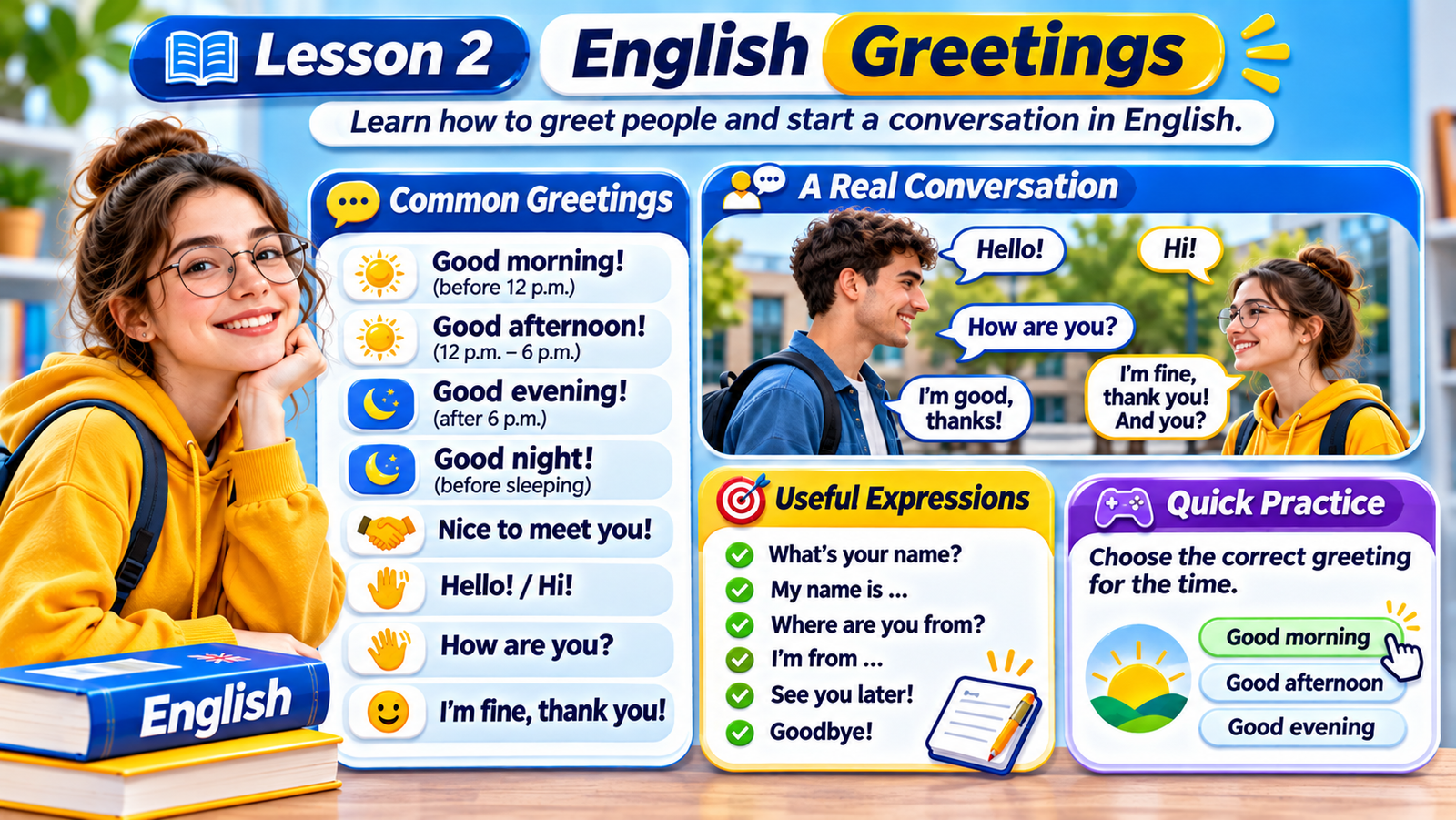
1. Common greetings
A greeting is something you say when you meet or contact another person.
| Expression | When to use it | Example |
|---|---|---|
| Hello. | Almost any situation; neutral and polite | Hello, Sara. |
| Hi! | Friendly, informal situations | Hi, Adam! |
| Good morning. | During the morning | Good morning, Ms. Lee. |
| Good afternoon. | After midday, before evening | Good afternoon, everyone. |
| Good evening. | When greeting someone in the evening | Good evening, Mr. Brown. |
Remember: “Good night” is usually a farewell before sleep or when leaving late in the evening, not a normal greeting when you arrive.
2. Say your name and ask for a name
Use I'm + name or My name is + name to introduce yourself. Both are correct. “I'm” is a short form of “I am.”
- Hi, I'm Maya.
- Hello. My name is Daniel.
- What's your name? — My name is Leila.
- May I ask your name? — I'm Omar. (more polite or formal)
To respond when meeting someone, say Nice to meet you. The other person can reply Nice to meet you, too.
Mini conversation: first day of class
Amina: Hi! I'm Amina. What's your name?
Leo: Hello, Amina. My name is Leo.
Amina: Nice to meet you, Leo.
Leo: Nice to meet you, too.
Notice: The names begin with capital letters. The question “What's your name?” ends with a question mark.
3. Ask how someone is
How are you? is a common, friendly question. You can answer briefly and ask the question back.
| Question | Natural answer |
|---|---|
| How are you? | I'm fine, thanks. And you? |
| How are you today? | I'm good, thank you. |
| How's it going? (informal) | Pretty good, thanks. |
| Are you okay? | Yes, I'm okay. Thanks for asking. |
You do not have to say “fine” if you are not feeling fine. You can say I'm a little tired or Not great today, depending on the situation.
Mini conversation: at the office
Nora: Good morning, Ben. How are you?
Ben: I'm good, thanks. How about you?
Nora: I'm fine, thank you.
4. Formal and informal English
Choose words that fit the person and situation. With a friend, Hi! is natural. When meeting a teacher, customer, or new colleague, Hello or Good morning is a safe choice.
| Informal | Neutral or more formal |
|---|---|
| Hey, I'm Sam. | Hello, my name is Sam. |
| What's your name? | May I ask your name? |
| See you! | Goodbye. Have a nice day. |
Culture note: A smile and a friendly tone can matter as much as the words. Not every culture uses the same greeting gestures, so follow the other person's lead.
5. Say goodbye
Use a farewell when you finish a conversation.
- Goodbye. — neutral and appropriate in many situations.
- Bye! — common and friendly.
- See you later. — when you expect to meet again.
- Have a nice day. — a polite wish when leaving.
- Good night. — often before going to bed or leaving at night.
Mini conversation: leaving a shop
Customer: Thank you for your help.
Shop assistant: You're welcome. Have a nice day!
Customer: You too. Goodbye!
6. Pronunciation and speaking practice
English speakers often join words together in natural speech. Start slowly, then repeat each expression at a comfortable speed.
- Say Hello three times, stressing the second syllable: he-LLO.
- Say Good morning and Good evening. Notice that “good” is the same word in both.
- Say My name is … and insert your own name.
- Ask What's your name? and pause as if waiting for an answer.
- Practice Nice to meet you and Nice to meet you, too with a partner.
Practice tip: Record yourself saying the two class introductions above. Listen for clear words and a friendly question intonation. Different English accents may pronounce these expressions differently.
7. Three real-life situations
Situation A: meeting a new neighbor
You: Hello! I'm Hana. I live next door.
Neighbor: Hi, Hana. I'm Peter.
You: Nice to meet you.
Neighbor: Nice to meet you, too.
Situation B: joining an online class
Teacher: Good afternoon. What's your name?
You: My name is Sofia.
Teacher: Welcome, Sofia. How are you today?
You: I'm good, thank you.
Situation C: ending a phone call
Friend: Thanks for calling!
You: No problem. See you later!
Friend: Bye!
8. Common beginner mistakes
| Less natural or incorrect | Better English | Why? |
|---|---|---|
| My name Sara. | My name is Sara. | The verb “is” is needed. |
| What your name? | What's your name? | “What's” means “What is.” |
| Good night! (when arriving at a dinner) | Good evening! | “Good evening” is a greeting; “good night” is usually a farewell. |
| Nice meet you. | Nice to meet you. | Use “to” before “meet.” |
| i'm ali. | I'm Ali. | Capitalize “I” and names. |
9. Practice activities
Activity A: choose the best expression
- You meet your teacher at 9:00 a.m. Say: (a) Good night (b) Good morning (c) Goodbye
- A new student says, “I'm Ella.” Reply: (a) Nice to meet you (b) Good night (c) See you yesterday
- Your friend asks, “How are you?” Reply: (a) My name (b) I'm good, thanks (c) Good evening is
- You are leaving your friend's home. Say: (a) What's your name? (b) Hello! (c) See you later!
Activity B: fill in the missing word
- My name ___ Karim.
- Nice ___ meet you.
- What ___ your name?
- I'm fine, ___. And you?
Activity C: write your own conversation
Write four lines: (1) greet someone, (2) say your name, (3) ask their name, (4) say “Nice to meet you.” Then read your conversation aloud.
10. Answers and explanations
- (b) Good morning. It is a suitable morning greeting.
- (a) Nice to meet you. This is a polite response to a first introduction.
- (b) I'm good, thanks. This answers the question about how you feel.
- (c) See you later! It is a natural farewell.
- is. “My name is Karim” needs the verb “is.”
- to. The expression is “Nice to meet you.”
- is. “What is” can be shortened to “What's.”
- thanks. “I'm fine, thanks” is a common polite answer.
Self-check: If you can greet a person, say your name, ask their name, and say goodbye without reading, you have reached this lesson's main goal.
Frequently asked questions
Is “Hi” rude?
No. “Hi” is a normal friendly greeting. “Hello” is often a safer choice in more formal situations.
What is the difference between “Good evening” and “Good night”?
Use “Good evening” to greet someone in the evening. Use “Good night” mainly when leaving or going to sleep.
Can I say “I'm good” instead of “I'm fine”?
Yes. Both are common answers to “How are you?” in everyday conversation.
Do I need to say “Nice to meet you” every time?
No. It is most useful when meeting someone for the first time. With someone you already know, a greeting and “How are you?” are usually enough.
Lesson summary
Use Hello or Hi to greet someone. Say I'm … or My name is … to introduce yourself. Ask What's your name? to learn someone's name. Respond with Nice to meet you, and finish with Goodbye or See you later. Practice these expressions in short conversations until they feel natural.
Listen, Practice & Play
Listen to the examples, check your understanding, and match related expressions. Audio uses your device's text-to-speech voice.
Listen & Repeat
Select a sentence to listen.
Knowledge Quiz
Matching Game
Choose one item on the left and its match on the right.
Finished studying this lesson?
Mark it complete to save your progress on this device.