Months and Seasons in English: Dates and Everyday Expressions
Learn the 12 months, four seasons, month spelling, dates and natural expressions for birthdays, holidays and weather.
What you will learn
Months and seasons help us talk about birthdays, travel, weather and plans. Learn the twelve months in order, how to write dates, and how seasons differ around the world.
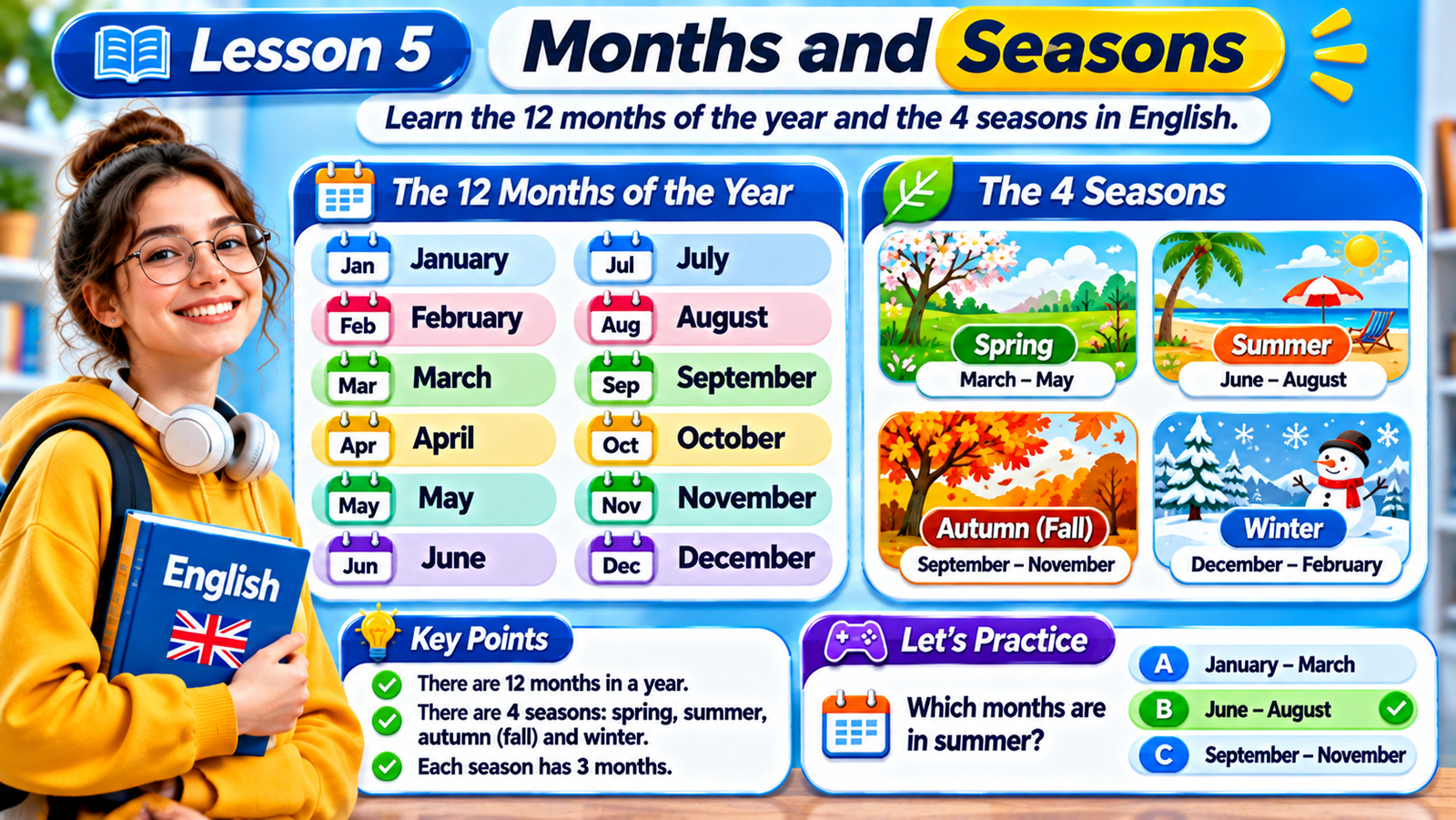
1. The twelve months
| No. | Month | Days |
|---|---|---|
| 1 | January | 31 |
| 2 | February | 28 or 29 |
| 3 | March | 31 |
| 4 | April | 30 |
| 5 | May | 31 |
| 6 | June | 30 |
| 7 | July | 31 |
| 8 | August | 31 |
| 9 | September | 30 |
| 10 | October | 31 |
| 11 | November | 30 |
| 12 | December | 31 |
February has 29 days in a leap year, usually every four years, with exceptions for some century years. Month names always start with a capital letter.
2. Learn the four seasons
The four commonly taught seasons are spring, summer, autumn (also called fall), and winter. In many Northern Hemisphere locations, spring is around March–May, summer June–August, autumn September–November and winter December–February.
Important: In the Southern Hemisphere, these seasons occur at opposite times of year. In some tropical regions, people more often describe rainy and dry seasons.
- Spring: Plants often grow and flowers appear.
- Summer: Days are often warmer and longer.
- Autumn / fall: Leaves may change colour and fall.
- Winter: Weather is often colder in temperate climates.
3. Use “in” with months and seasons
Use in before a month or season: “My birthday is in May.” “We travel in summer.” Use on for a specific calendar date: “My birthday is on May 12.”
Compare: “School starts in September.” / “School starts on September 3.”
4. Talking about dates
In American English, dates are often written as May 12, 2026. In British English, 12 May 2026 is common. The numeric date 05/06/2026 can mean different things in different countries, so writing the month as a word helps avoid confusion.
We usually say dates with ordinal numbers: “May twelfth” or “the twelfth of May”.
5. Real-life conversation
A: When is your birthday?
B: It is in October.
A: What date?
B: October nineteenth.
A: What is your favourite season?
B: I like spring because the weather is mild.
Try replacing October with your birth month and spring with a season you enjoy.
6. Common mistakes and review
- Incorrect: My birthday is on July. Correct: My birthday is in July.
- Incorrect: I travel in 15 August. Correct: I travel on 15 August.
- Incorrect: september. Correct: September.
- Incorrect: All countries have summer in July. Better: Seasons vary by hemisphere and climate.
Practice: Write your birth month, today’s month, and a month you want to travel. Then write two sentences using in and one using on.
Lesson recap
Review the key patterns above, listen again to the examples, complete the quiz, and play the matching game. For lasting progress, practise the new words in your own sentences.
Listen, Practice & Play
Listen to the examples, check your understanding, and match related expressions. Audio uses your device's text-to-speech voice.
Listen & Repeat
Select a sentence to listen.
Knowledge Quiz
Matching Game
Choose one item on the left and its match on the right.
Finished studying this lesson?
Mark it complete to save your progress on this device.