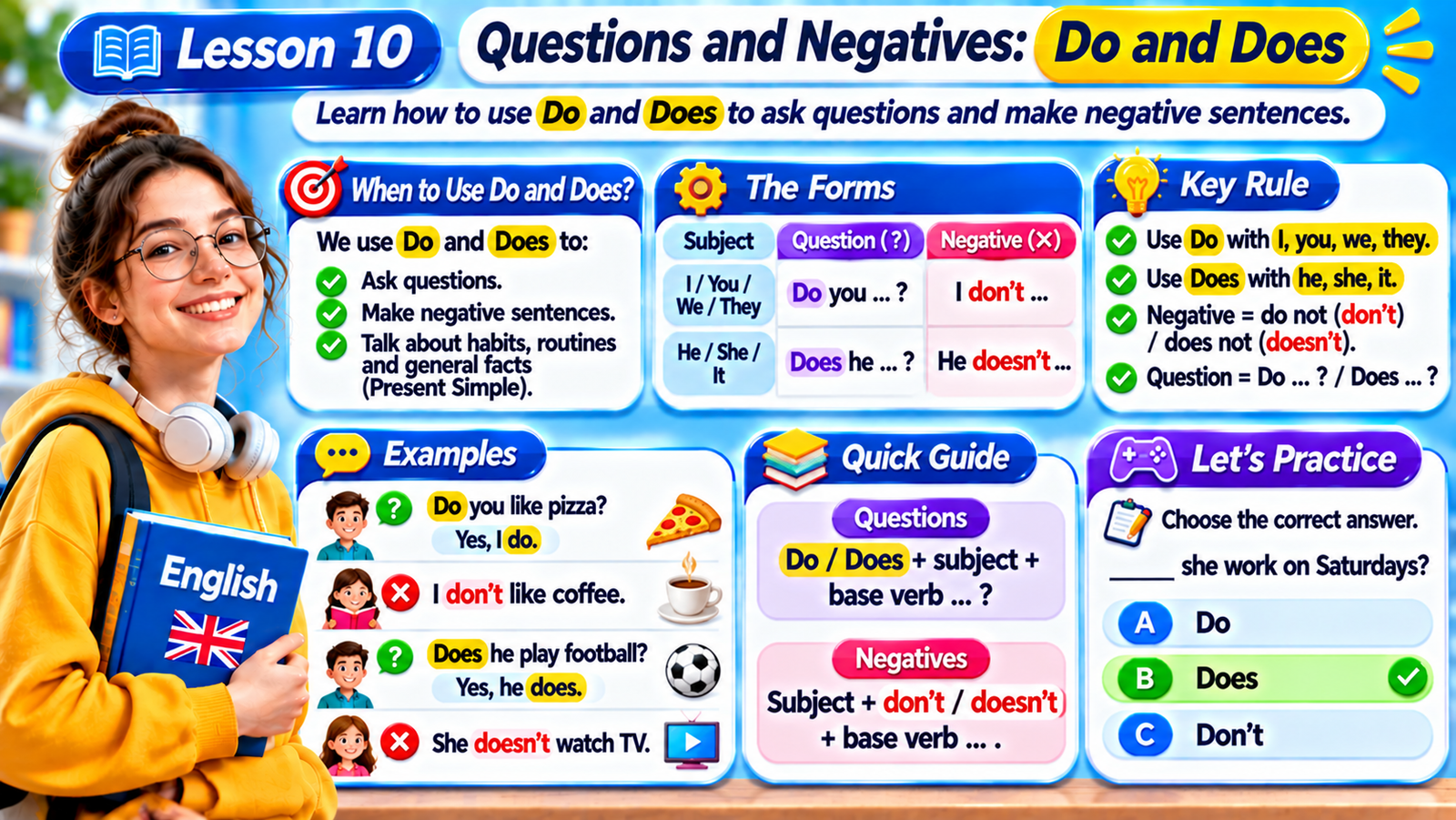
Present Simple: Daily Routines and Habits
Learn the present simple for habits, daily routines and facts, including he/she/it endings and time expressions.
Learning goals
The present simple helps you describe what you do regularly and what is generally true. You can use it to talk about work, school, hobbies, meals and everyday routines.
1. When do we use the present simple?
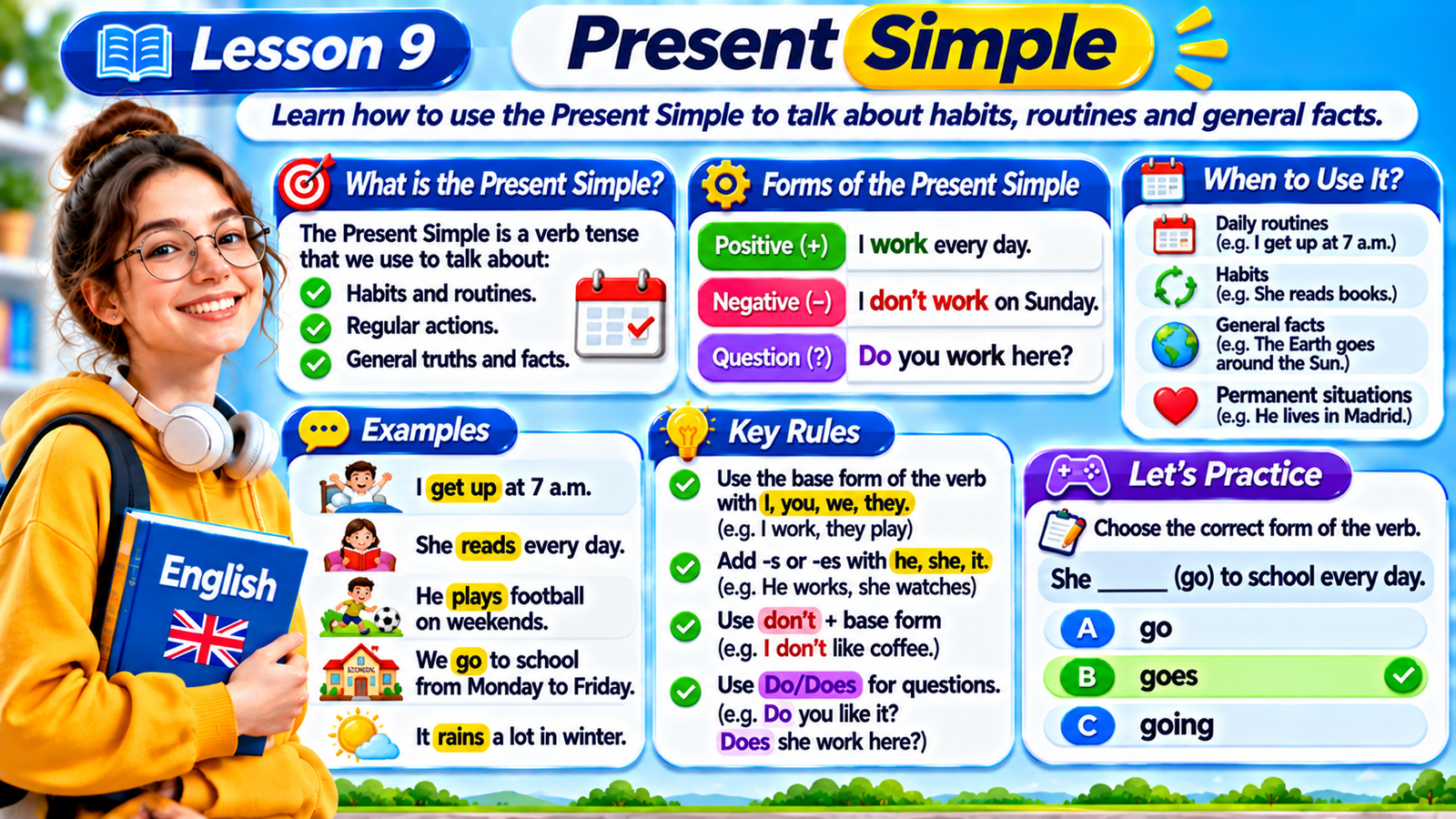
Use the present simple for habits: “I drink tea every morning”; routines: “She walks to school”; and general facts: “Water freezes at about 0°C at standard atmospheric pressure.” This lesson focuses on positive statements. You will practise questions and negatives in the next lesson.
2. Make positive sentences
| Subject | Verb | Example |
|---|---|---|
| I / You / We / They | work | They work on weekdays. |
| He / She / It | works | He works on weekdays. |
With he, she and it, most verbs take -s: “I play / She plays.” “We read / He reads.”
3. Spelling rules: -s, -es and -ies
Most verbs add -s: work → works, read → reads. Verbs ending in -ch, -sh, -ss, -x often add -es: watch → watches, wash → washes, pass → passes, fix → fixes. For a consonant + y, change y to -ies: study → studies. For a vowel + y, add -s: play → plays. Irregular common forms: do → does; go → goes; have → has.
4. Time expressions and frequency
Useful phrases include every day, every morning, on Mondays, usually, often, sometimes, never. Frequency adverbs usually come before the main verb: “I usually eat breakfast at seven.” “She often reads at night.” With be, they usually come after the verb: “He is always early.”
5. Read a daily routine
Meet Nora: Nora gets up at seven. She eats breakfast and takes the bus to work. She starts work at nine. After work, she cooks dinner and reads for twenty minutes. On Fridays, she visits her family.
Check understanding: What time does Nora get up? (At seven.) Does she read after work? (Yes.) What does she do on Fridays? (She visits her family.)
Now describe your own day in four short sentences.
6. Common mistakes and practice
- Incorrect: He work every day. Correct: He works every day.
- Incorrect: She studys English. Correct: She studies English.
- Incorrect: They goes to school. Correct: They go to school.
- Incorrect: I am play football every Saturday. Correct: I play football every Saturday.
Speaking task: Explain your morning routine using first, then, after that, and finally. Writing task: Write five sentences about someone you know; check every he/she/it verb.
Self-check and next step
Listen to the examples once at normal speed and once slowly. Complete the quiz without looking back, then replay any phrases you found difficult. Finish with the matching game and write two original sentences using today’s language.
Listen, Practice & Play
Listen to the examples, check your understanding, and match related expressions. Audio uses your device's text-to-speech voice.
Listen & Repeat
Select a sentence to listen.
Knowledge Quiz
Matching Game
Choose one item on the left and its match on the right.
Finished studying this lesson?
Mark it complete to save your progress on this device.