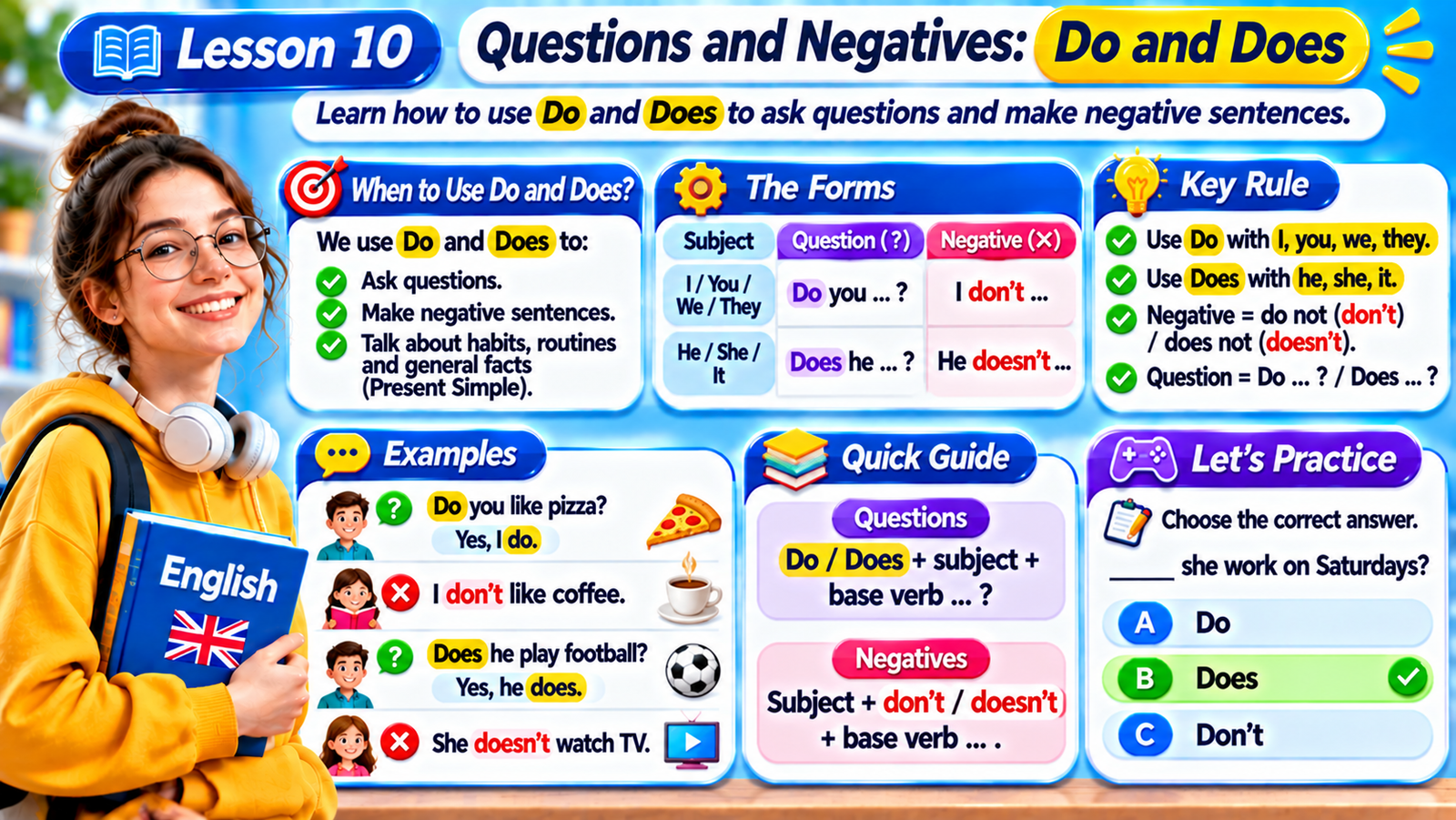
Present Simple Questions and Negatives: Do and Does
Ask present simple questions, form negatives with do not and does not, and give accurate short answers.
Learning goals
You already know how to describe routines with the present simple. Now learn how to ask about other people’s habits and say what someone does not do.
1. Do and does in questions
| Subject | Question |
|---|---|
| I / you / we / they | Do you speak English? |
| he / she / it | Does she speak English? |
Pattern: Do/Does + subject + base verb + ...? Use does for he, she and it. After does, use the base verb: “Does he work?” not “Does he works?”
2. Short answers
Do you like coffee? Yes, I do. / No, I don’t.
Does she study English? Yes, she does. / No, she doesn’t.
Do they live nearby? Yes, they do. / No, they don’t.
In short answers, you do not need to repeat the main verb.
3. Make negative statements
Pattern: subject + do/does + not + base verb. “I do not work on Sundays.” “He does not eat meat.” Contractions: don’t = do not; doesn’t = does not.
Remember that doesn’t already shows the third-person form, so the main verb stays in its base form: “She doesn’t play tennis.”
4. Ask what, where and when
Use a question word before do or does: What do you eat for breakfast? Where does he work? When do they study? Why does she walk to school?
Compare: “Does he work here?” (yes/no question) and “Where does he work?” (asks for information).
5. Conversation: getting to know a classmate
A: Do you study English every day?
B: Yes, I do. I practise for fifteen minutes.
A: Does your brother study English too?
B: No, he doesn’t. He studies French.
A: Where do you usually study?
B: At home, after dinner.
Practise both roles. Then replace English with another subject and change the answers to make the conversation true for you.
6. Important exception: be
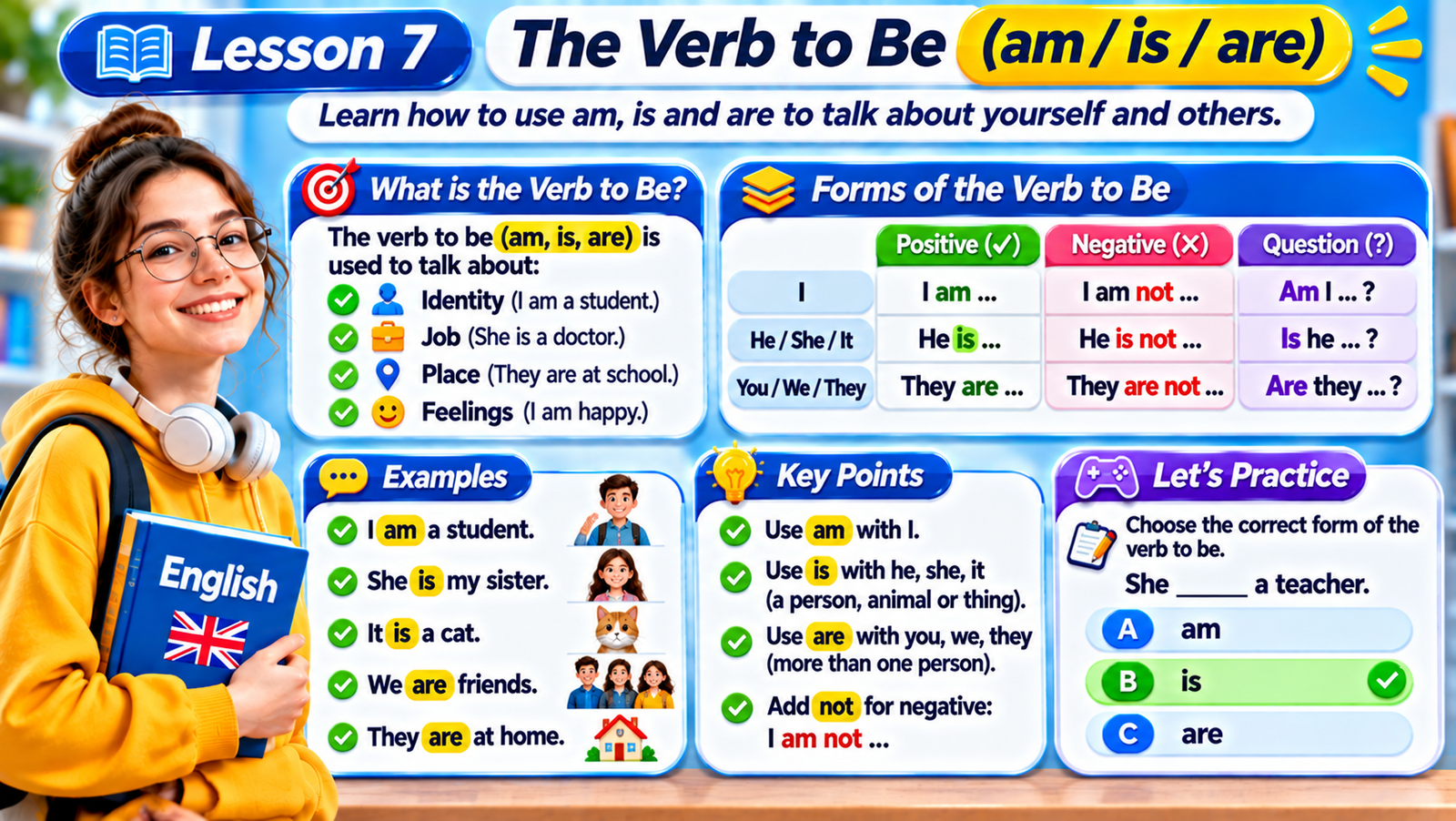
Do not use do/does to form ordinary questions and negatives with am/is/are: say “Are you ready?” not “Do you are ready?”; say “She isn’t tired” not “She doesn’t be tired.” Use the be forms from Lesson 7.
7. Common mistakes and independent practice
- Incorrect: Does she likes music? Correct: Does she like music?
- Incorrect: He don’t work. Correct: He doesn’t work.
- Incorrect: Where she lives? Correct: Where does she live?
- Incorrect: Do he play tennis? Correct: Does he play tennis?
Practice: Turn “She reads at night” into a question (Does she read at night?) and a negative (She doesn’t read at night). Do the same with “They work on Saturdays.”
Self-check and next step
Listen to the examples once at normal speed and once slowly. Complete the quiz without looking back, then replay any phrases you found difficult. Finish with the matching game and write two original sentences using today’s language.
Listen, Practice & Play
Listen to the examples, check your understanding, and match related expressions. Audio uses your device's text-to-speech voice.
Listen & Repeat
Select a sentence to listen.
Knowledge Quiz
Matching Game
Choose one item on the left and its match on the right.
Finished studying this lesson?
Mark it complete to save your progress on this device.