English Subject Pronouns: I, You, He, She, It, We and They
Understand the seven English subject pronouns, replace nouns correctly, and practise natural sentences and short conversations.
Learning goals
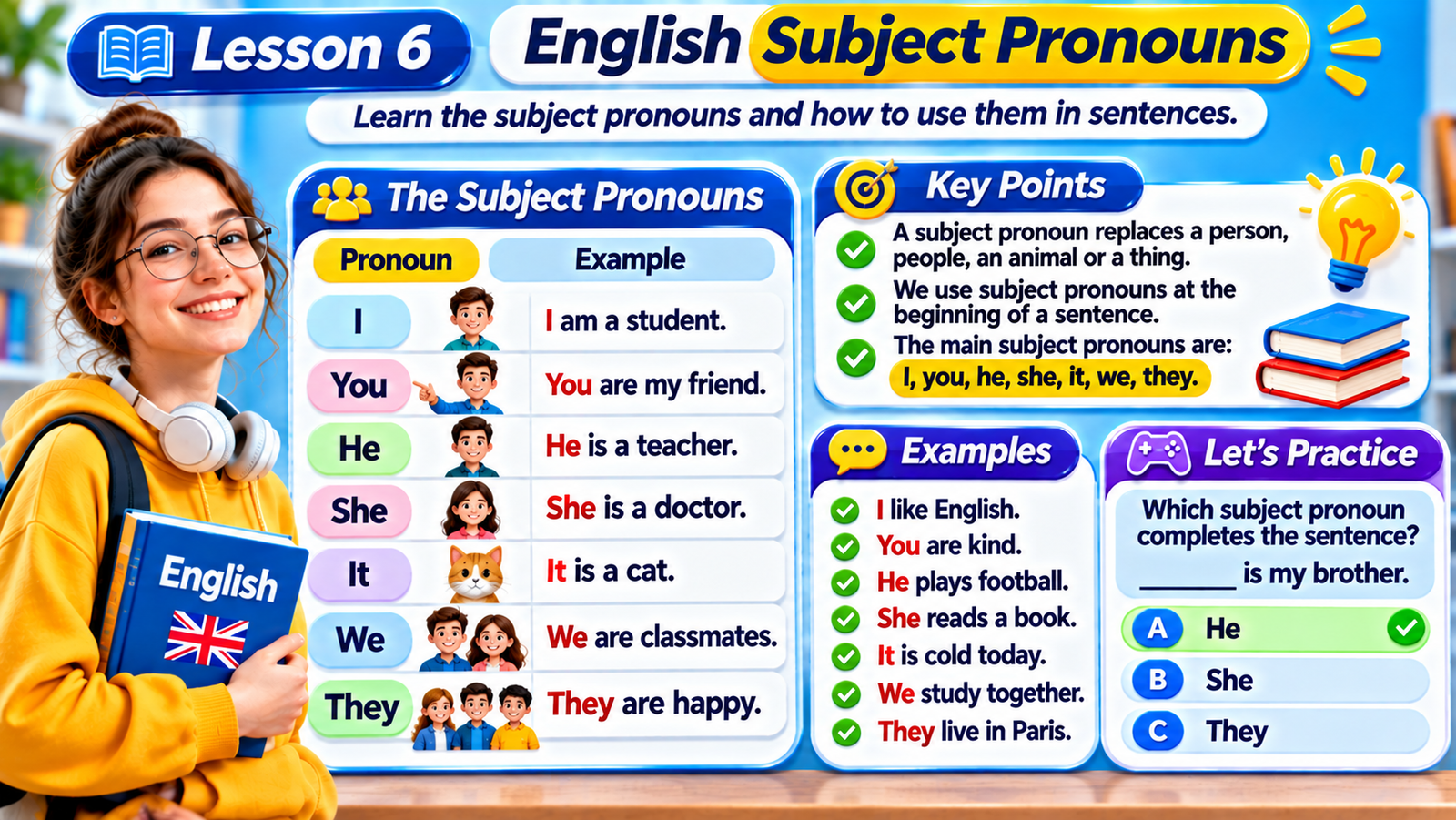
A subject pronoun tells us who or what does something. Instead of repeating a name, we can say he, she, it, or they. In this lesson, you will use all seven subject pronouns in meaningful sentences.
1. Meet the subject pronouns
| Pronoun | Meaning / use | Example |
|---|---|---|
| I | The speaker | I read every day. |
| You | One or more people you address | You speak English. |
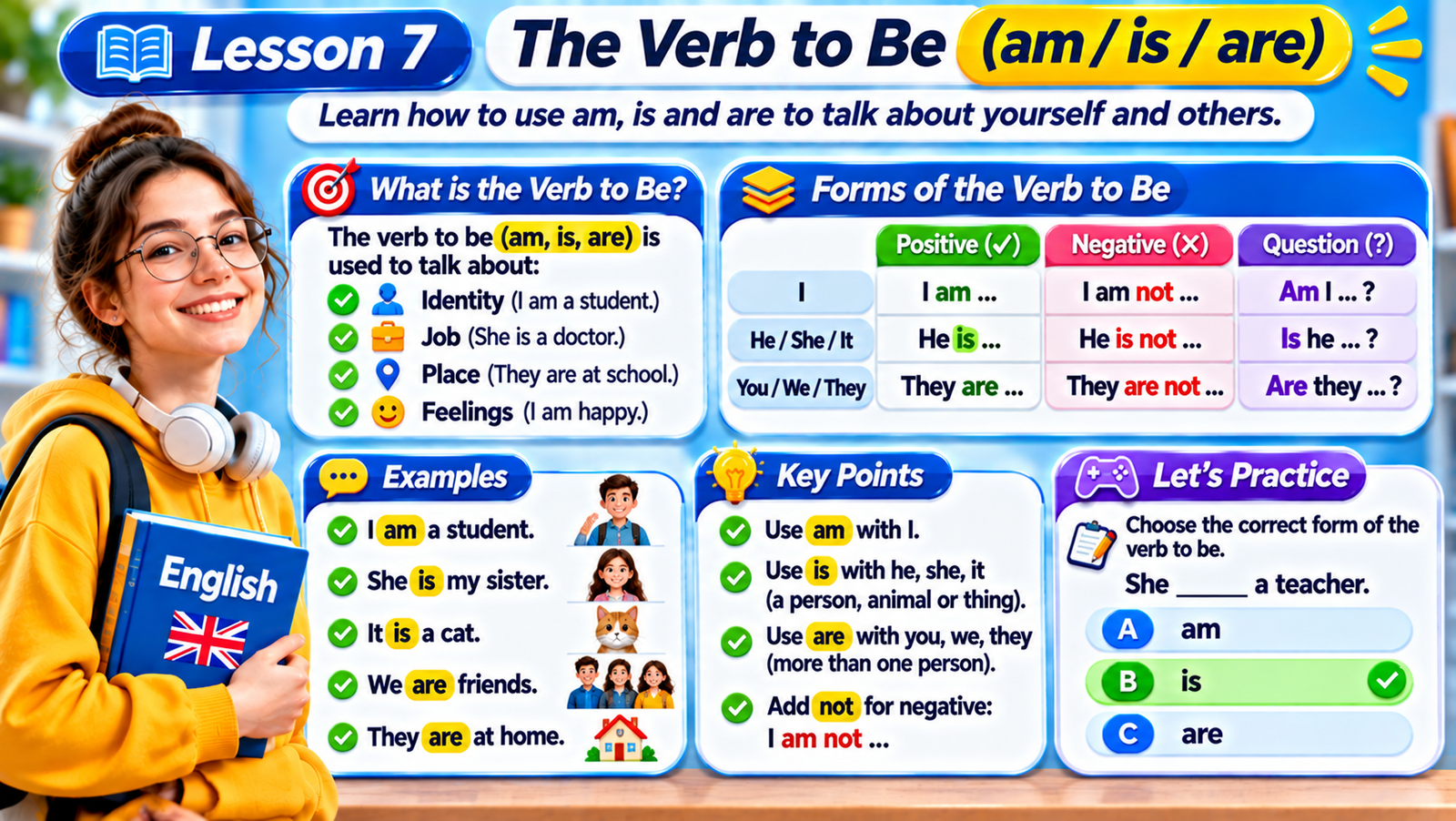
| He | One male person | He plays football. |
| She | One female person | She likes music. |
| It | One thing, animal, or situation | It is cold today. |
| We | The speaker and others | We study together. |
| They | People or things spoken about | They live nearby. |
English also uses singular they for a person whose gender is unknown or who uses that pronoun: “Someone left their umbrella. I hope they come back.”
2. Replace a name with a pronoun
Maria is my neighbour. She is friendly. Daniel is my cousin. He is sixteen. The book is on the table. It is new. Maria and Daniel are students. They are in the library.
Pronouns make your speech smoother, but use a name again if listeners might not know whom you mean.
3. I, you and we
Always write I with a capital letter, even in the middle of a sentence: “My friend and I study together.” The word you works for one person and a group. Use we when you include yourself with someone else: “My sister and I are ready. We can go.”
4. It and they
Use it for one object or situation: “Where is my phone? It is in my bag.” Use they for more than one: “Where are the keys? They are on the shelf.” For pets, speakers may use he or she when they know the animal’s sex.
5. Real conversation
A: Is that your brother?
B: Yes. He is a student.
A: And who are those people?
B: They are my friends.
A: Are you all in the same class?
B: Yes, we are.
Read both roles aloud. Then change brother to sister and he to she.
6. Common mistakes and practice
- Incorrect: me am happy. Correct: I am happy.
- Incorrect: i live here. Correct: I live here.
- Incorrect: The books is new. It are expensive. Correct: The books are new. They are expensive.
Practice: Replace the subject with a pronoun: “Ahmed is here” → “He is here”; “My parents are at work” → “They are at work”; “My friend and I are ready” → “We are ready.” Now write three sentences about people you know.
Self-check and next step
Listen to the examples once at normal speed and once slowly. Complete the quiz without looking back, then replay any phrases you found difficult. Finish with the matching game and write two original sentences using today’s language.
Listen, Practice & Play
Listen to the examples, check your understanding, and match related expressions. Audio uses your device's text-to-speech voice.
Listen & Repeat
Select a sentence to listen.
Knowledge Quiz
Matching Game
Choose one item on the left and its match on the right.
Finished studying this lesson?
Mark it complete to save your progress on this device.