The English Alphabet: Letters, Sounds and Pronunciation
Learn all 26 English letters, vowel and consonant letters, basic pronunciation patterns, spelling, and capitalization with practical examples and a self-check quiz.
What will you learn?
English uses 26 letters to write words. In this lesson, you will recognize every letter, say its name, identify vowels and consonants, and spell simple words. You will also learn why a letter's name is not always the sound it makes in a word.
1. The 26 letters of the English alphabet
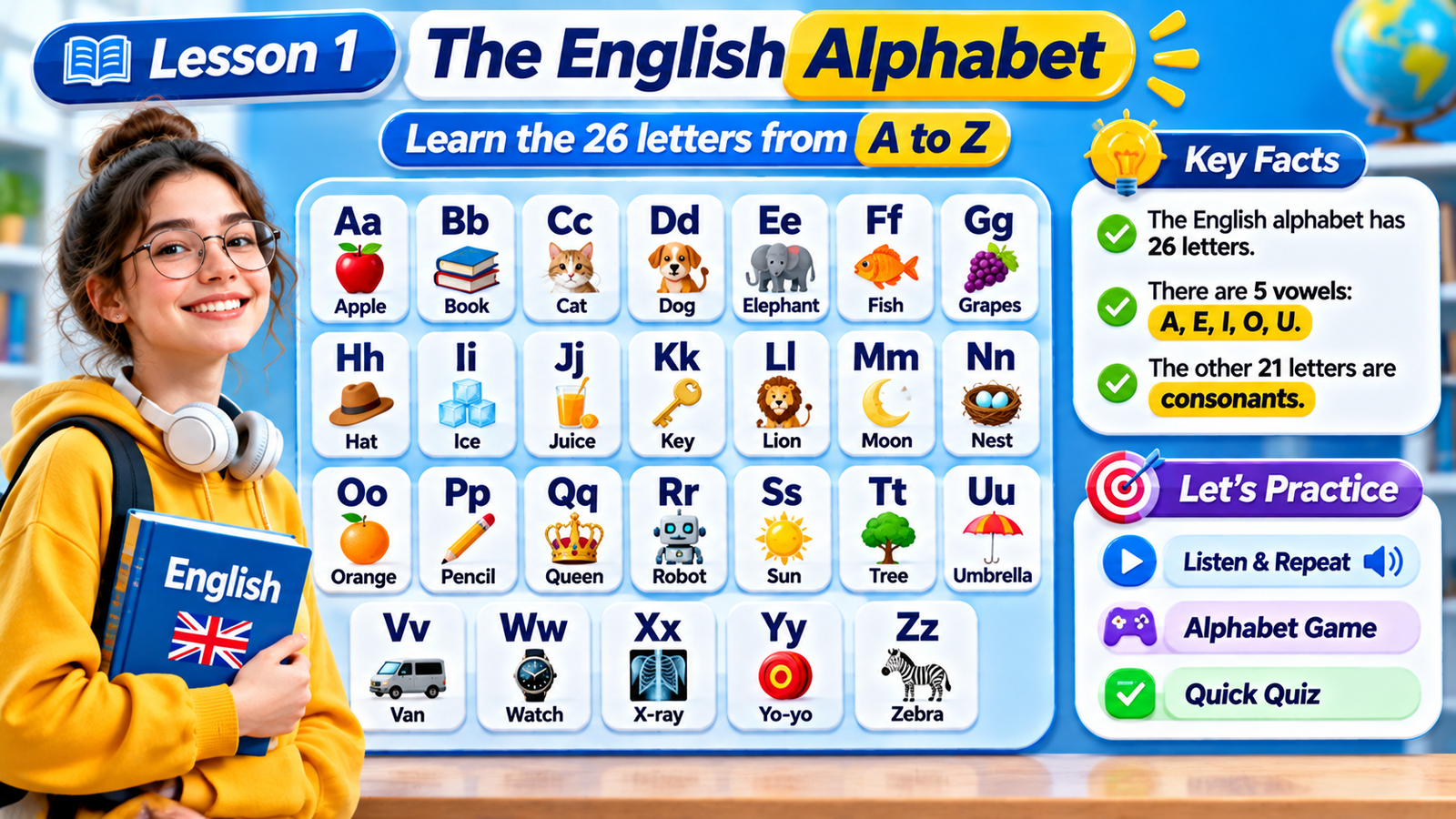
English has 26 letters. Each letter has an uppercase (capital) and a lowercase form. Capital letters begin sentences and names: My name is Lina.
| Uppercase | Lowercase | Letter name (approximate) | Example |
|---|---|---|---|
| A | a | ay | apple |
| B | b | bee | book |
| C | c | see | cat |
| D | d | dee | dog |
| E | e | ee | egg |
| F | f | ef | fish |
| G | g | jee | goat |
| H | h | aych | hat |
| I | i | eye | ink |
| J | j | jay | jam |
| K | k | kay | kite |
| L | l | el | lamp |
| M | m | em | moon |
| N | n | en | nose |
| O | o | oh | orange |
| P | p | pee | pen |
| Q | q | cue | queen |
| R | r | ar | rain |
| S | s | ess | sun |
| T | t | tee | tree |
| U | u | you | umbrella |
| V | v | vee | van |
| W | w | double-you | water |
| X | x | ex | box |
| Y | y | why | yellow |
| Z | z | zee (US) / zed (UK) | zebra |
Pronunciation note: These spellings are simple guides, not exact phonetic transcriptions. Listen to a reliable dictionary recording when practicing unfamiliar sounds. The name of Z is commonly “zee” in American English and “zed” in British English.
2. Vowels and consonants
The five main vowel letters are A, E, I, O, U. The other 21 letters are generally called consonant letters. The letter Y sometimes represents a vowel sound, as in my or happy.
- apple starts with vowel letter A.
- egg starts with vowel letter E.
- sun starts with consonant letter S.
- yellow starts with consonant letter Y.
Important: vowel letters and vowel sounds are different ideas. For example, university begins with the vowel letter U but starts with a /y/ sound, so we say a university. We say an hour because its first sound is a vowel even though it begins with H.
3. A letter's name is not always its sound
When you say the alphabet, you say letter names. When you read a word, letters work together to represent sounds. For example, the letter A is called “ay,” but in cat it represents a different sound. In cake, the letter A sounds like its name.
- C: cat begins with a /k/ sound; city begins with an /s/ sound.
- G: go begins with a hard /g/ sound; giant begins with a /j/ sound.
- SH: ship begins with one sound written using two letters.
- TH: think and this begin with two different English TH sounds.
Do not expect every English word to sound exactly as it is spelled. Learn common letter patterns and practice whole words.
4. Uppercase and lowercase in real sentences
Use a capital letter at the start of a sentence, for the pronoun I, and for names of people, places, and days.
- Correct: I live in London.
- Correct: Sara studies English on Monday.
- Incorrect: i live in london.
5. How to spell your name in English
Spelling means saying or writing letters in order. You can ask someone to repeat the letters if you did not hear clearly.
Dialogue:
Teacher: What's your name?
Student: My name is Maya.
Teacher: How do you spell that?
Student: M-A-Y-A.
Teacher: Thank you, Maya!
Try it: Say “My name is …” and then spell your name letter by letter. Practice slowly first, then at a natural speed.
6. Pronunciation practice: five short activities
- Alphabet chunks: Say A–G, H–N, O–T, and U–Z separately. Repeat each group twice.
- Similar letter names: Practice B / P, M / N, and G / J. Listen carefully before repeating.
- Vowels: Say A, E, I, O, U. Then say apple, egg, ink, orange, umbrella.
- Spell words: Spell CAT, BOOK, and SUN aloud.
- Write and say: Write three short sentences about yourself, using capital letters correctly.
7. Common beginner mistakes
- Confusing B and P: Their names sound similar. Focus on the first sound and the ending.
- Using lowercase i: The English pronoun I is always capitalized.
- Assuming letters always have one sound: Compare C in cat and city.
- Forgetting spelling order: Write the word as you say each letter.
8. Check your understanding
Answer these questions before opening the answer key.
- How many letters are in the English alphabet?
- What are the five main vowel letters?
- Which is correct: “i am sam.” or “I am Sam.”?
- Spell the word dog letter by letter.
- Does the letter C always represent the same sound?
- Which letter is sometimes used to represent a vowel sound: Y or B?
Show answers and explanations
- 26. English uses 26 alphabet letters.
- A, E, I, O, U. These are the five main vowel letters.
- I am Sam. Capitalize I, the beginning of the sentence, and the name Sam.
- D-O-G. Say each letter name in order.
- No. C represents different sounds in cat and city.
- Y. It represents a vowel sound in words such as my and happy.
9. Your five-minute practice plan
Minute 1: Read A–Z aloud. Minute 2: Say the five vowel letters. Minute 3: Spell your name and three objects around you. Minute 4: Read the sample dialogue aloud. Minute 5: Answer the six questions again without looking.
Frequently asked questions
How many letters are in the English alphabet?
There are 26 letters, from A to Z.
Are there five or six vowels in English?
A, E, I, O and U are the five main vowel letters. Y can also represent a vowel sound in some words.
Should beginners learn letter names or letter sounds first?
Both matter. Letter names help with spelling; letter sounds help with reading and pronunciation. Practice them together using short words.
Why is Z pronounced differently?
The name is commonly “zee” in American English and “zed” in British English. Both are standard varieties.
Lesson summary
You can now recognize all 26 letters, distinguish uppercase and lowercase, identify the five main vowel letters, and spell simple words. Next, practice using these skills to greet someone and introduce yourself in English.
Listen, Practice & Play
Listen to the examples, check your understanding, and match related expressions. Audio uses your device's text-to-speech voice.
Listen & Repeat
Select a sentence to listen.
Knowledge Quiz
Matching Game
Choose one item on the left and its match on the right.
Finished studying this lesson?
Mark it complete to save your progress on this device.